


Protected: About
UM6P Science Week 2023 – Complexity Summit
 Mohamed VI Polytechnic University, Benguerir, 20-26 February 2023
Programme [ English – Français ]
Communiqué [ English – Français – العربية ]
Keynote Speakers: Edgar Morin, Stephen Wolfram, Luc Steels, Gregory Chaitin, Stuart Kauffman, Ivar Ekeland, Hervé Zwirn, Geoffrey West
UM6P Science Week 2023 – Complexity Summit
Organizers: Fouad Laroui, Saâd Tazi, Reda Benkirane
{ Plenary Sessions / Adam Smith Tercentenary / Complexité et management (Africa Business School) / Complexity and Algorithms (School of Computer Science) / Complex Problems and Collective Solutions (School of Collective Intelligence) / Complexité et simplicité en architecture (School of Architecture, Planning and Design) / Complexités du développement durable (Sustainable Agriculture and Environmental Sciences) / Technical, institutional and political complexity (International Water Research Institute) / Harmonizing complexity: perceptions from natural and social sciences (Materials Science, Energy and Nano-Engineering) / Complexité en management hospitalier (Medical School) }
[ UM6P Content Factory short videos/ Photos gallery ]
Plenary Sessions
Séances plénières
Monday 20 February 2023

Drawings: Sophie Lenormand
Fouad Laroui, Welcoming
Hicham El Habti, President of UM6P, Opening Speech (7mn)
Fouad Laroui, Why Complexity? (7mn)
Reda Benkirane, Complexity, Golden Age, Dark Age (10mn)
Saâd Abdesslam Tazi, Complexité, modalités pratiques (5mn)
Complexity, Practical Modalities
A message from Dr. Tuwana KUPE, vice-chancellor of the University of Pretoria (5mn)
Edgar Morin, Le défi des complexités en temps de crise (24mn)
The Challenges of Complexities in Times of Crisis
Stephen Wolfram, Foundations and Implications of Complexity (54mn)
Signature, Fund of Louise Fresco (10mn)
David Chavalarias, Toxic Data (1h07mn)
Roundtable with Luc Steels
Moderator: Reda Benkirane

Jamal Chaouki, Comment les entreprises gèrent-elles la complexité (34mn)
How does the Mighty Industry deal with the Complex

Steen Rasmussen, Engineering Artificial Living Materials (34mn)

Hassan Ghaziri, L’ingénieur de demain, entre artefactualisation et complexification (23mn)
Tomorrow’s Engineer, between Artifacts and Complexification

Complexité et ingénierie (33mn)
Complexity and Engineering
Roundtable with Jamal Chaouki, Steen Rasmussen and Hassan Ghaziri
Moderator: Saâd Abdeslam Tazi
Luc Steels, Promises and Limitations of Contemporary AI (52mn)

Hugues Bersini, Algocratie: les algorithmes vont-ils prendre le pouvoir? (46mn)
Algocracy: Will Algorithms Take Over?

Hervé Zwirn, Computational Irreducibility and Emergence (34mn)

Gregory Chaitin, Complexity in Metamathematics, Friend or Foe? (1h26mn)
Roundtable with Stephen Wolfram, Hervé Zwirn and David Chavalarias
Moderator: Fouad Laroui

Stuart Kauffman, The Inevitable Anthropocene and our Choices Now: Prolegomenon to a Next Axial Age (58mn)

Ivar Ekeland, The Climate Change. Transition, Bifurcation or Catastrophe? (46mn)

Johan Bollen, Toxic Networks (51mn)

Session Africa Business School
Complexity and Management
Jean Staune, Comment les principes de la complexité peuvent guider l’organisation des entreprises (30mn)
How Complexity Principles can Guide Business Organization

Amine Belemlih, Le leadership face à la complexité: une perspective par les pratiques (29mn)
Leadership in the Face of Complexity: A Practice Perspective

Complexité et management
Complexity and Management
Table ronde avec Jean Staune, Amine Belemlih, Hervé Zwirn et Ivar Ekeland
Modératrice: Yasmina Lamtiri
Lancement de la chaire Complexités ∞ Humanités (41mn)
Launch of the Chair Complexities ∞ Humanities
Table ronde avec Hicham El Habti, Gregory Chaitin, Stuart Kauffman, Hassan Ghaziri et Reda Benkirane
Modératrice: Yasmina Lamtiri
Session School of Computer Science
Complexity and Algorithms
Welcoming, Fouad Laroui (3mn)
Opening, Rachid Guerraoui (10mn)
Moshe Vardi, From Aristotle to the Iphone (27mn)

Javier Esparza, The Science of Algorithms (38mn)

Pierre Fraignaud, Locality in Distributed Computing (41mn)

Sergio Rajsbauma, Geometric Explanation of the Impossibility of Democracy
(28mn)

Closing Ahmed Bouajjani and Rachid Guerraoui (6mn)
Raphael Liogier and Fréderic Baitinger, L’être humain est-il complexé avant d’être complexe ? (1h03mn)
Complex Individuals or Individuals full of Complexes?
Moderator: Saâd Abdeslam Tazi

Francis Heylighen, Emergence and Self-Organization (31mn)

Steen Rasmussen, Three Investigations of Human Wealth Evolution over the Last 800 Years (17mn)
0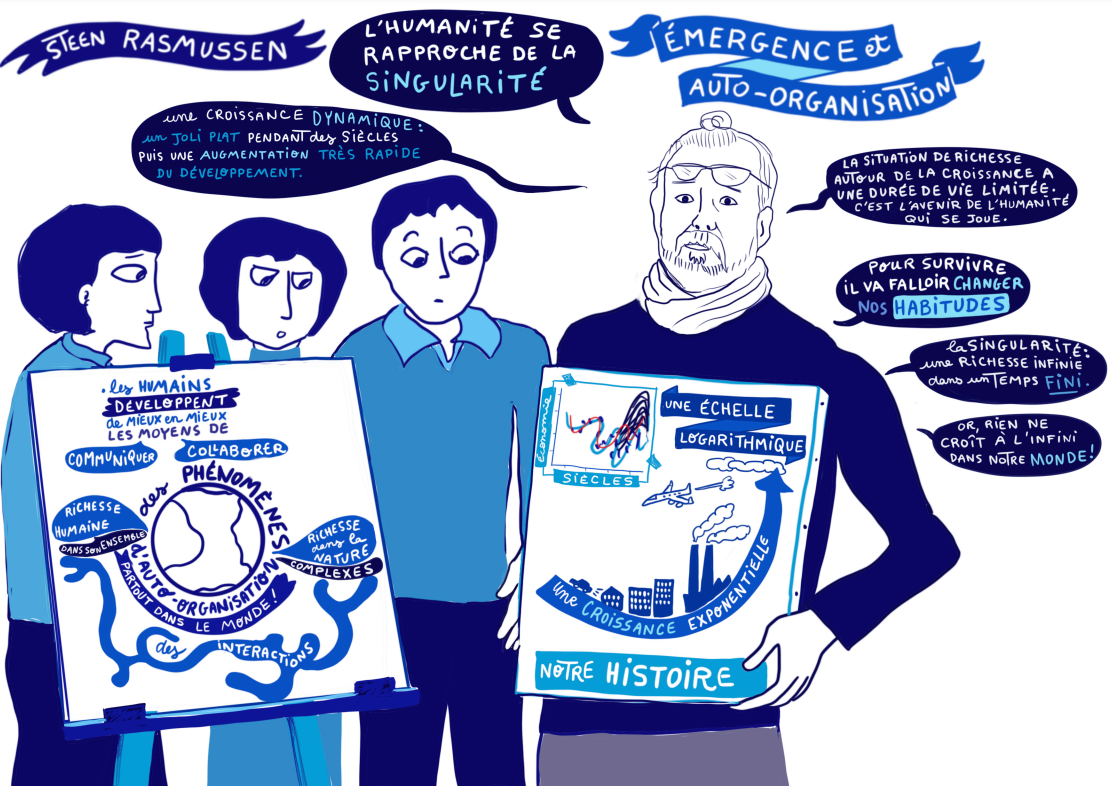
David Napier, Emergence and Self-Organization (24mn)

Emergence and Self-Organization (29mn)
Roundtable with Francis Heylighen, Steen Rasmussen, David Napier
Moderator: Johan Bollen
Session School of Collective Intelligence
Complex Problems and Collective Solutions

Stuart Kauffman, Commentary on Geoffrey West’s Talk (16mn)
Virginia Chaitin, Proposal for Tackling Biases in Algorithms with Social Impact (18mn)

David Napier, Complexity in Health Research: Why Measuring it Matters (16mn)

James Winters, Problem Discovery as a Hard Problem Constraint on Technological Evolution (21mn)

Katherine Peil Kauffman, Emotional Sentience and Collective Behavior (28mn)

Colloque Tricentenaire Adam Smith
Adam Smith Tercentenary Colloquium
Dany Robert- Dufour, Mandeville et le renversement de la métaphysique (45mn)
Pierre-Noel Giraud, Que nous ont légué Adam Smith et les classiques? (45mn)
Alain Kirman, La main invisible, Mythe ou réalité ? (34mn)
Table Ronde, Fouad Laroui (22mn)
Muhammed Ali Yildirim, Specialization of Knowledge and Economic Complexity (44mn)
Division des connaissances et complexité économique
Redouane Taouil, La macro économie est elle en crise? (29mn)
Table ronde, Modération Amine Belemlih (12mn)
Atelier Agriculture durable et sciences de l’environnement
Naviguer dans les complexités du développement durable
Bruno Gérard, Dimensions de la complexité dans l’agriculture durable en Afrique (44mn)
Daniel Nahon, Systèmes complexes naturels, application à l’agriculture (34mn)
Oumar Ba (45mn)
Table Ronde, Saad A Tazi (18mn)
Raphaël Liogier, Alexandre Maurer, Est-ce que l’intelligence est une question de complexité (1h05)
Table ronde
Modération Saâd A. Tazi
Atelier Ecole d’architecture et de design
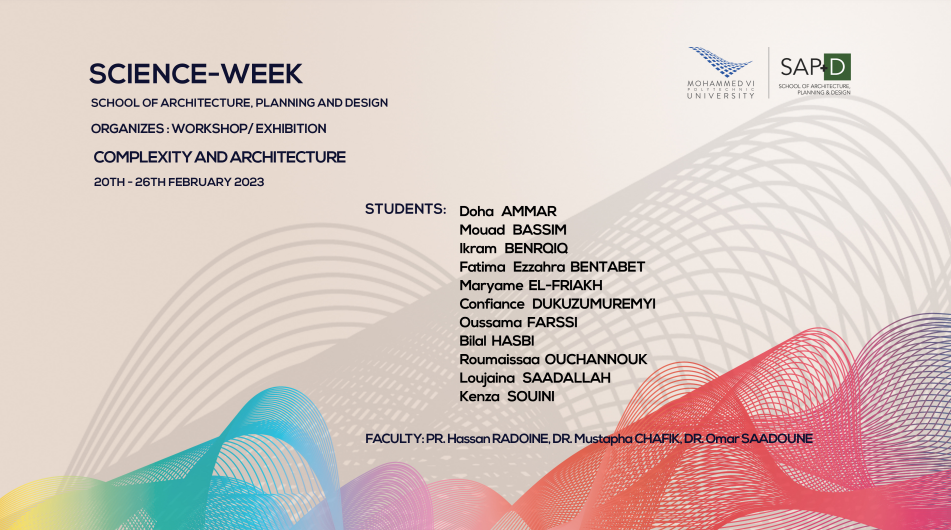
School of Architecture, Planning & Design ( SAP+D )
Simplicité et complexité en architecture (1h45)
Atelier sous la direction de Hassan Radoine
Thursday 23 February 2023
Workshop International Water Research Institute
Technical, institutional and political complexity
Ghani Chehbouni, Complexities in the Water Sector (22 mn)
Charafat Afilal, Managing Water Sector from Political and Strategic perspectives (13mn)
Dara Entekhabi (46mn)
Table Ronde (50mn)
Materials Science, Energy and Nano-Engineering
Harmonizing complexity: perceptions from natural and social sciences
Harmonizing complexity : perceptions from natural and social sciences – moderated by Jones Alami (17mn)
Jochen Schneider, Materials design and complexity (45mn)
Panel discussion (1h27mn)
Moderated by Jones Alami
with the participation of Tarik Sabry, Jochen Schneider, Ali Benmakhlouf and Jamal Belahrach
Atelier Faculté de médecine
Workshop Medicine Faculty / Medical School
Gabriel Malka, La complexité en management hospitalier (1h27mn)
Gilles Duhamel, Face à la complexité hospitalière (23mn)
UM6P Content Factory
Short videos
As a movement of thought, #Complexity is gaining ground in intellectual and scientific circles.
But Complexity did not come out of the blue. Its premises are based on an honest realization that the world around us is itself complex in functioning.
Throwback to UM6P Science Week 2023, where UM6P Live spoke to renowned thinkers on the matter.
One would think #technology, social sciences and economics barely intersect, because they tackle life from diverse perspectives. That could not be further from the truth.
It is one perception that the notion of Complexity has been dismantling for years now.
At UM6P Live, last time we witnessed such dismantling was during #UM6P Science Week 2023.
In fact, we seem to have found evidence of #Complexity amongst thinkers in the humanities, hard sciences and business!
In a world of rising connectedness, no phenomenon can be understood separately. No single speciality has a monopoly on making sense of life around us.
Enter the notion of #Complexity, which was the guiding theme of this year’s #UM6P Science Week.
As always, UM6P Live was there to capture the inspiring dynamics of students, guests and prestigious scholars from across the world.
UM6P
Mohammed VI Polytechnic University
Université Mohamed VI Polytechnique
جامعة محمد السادس متعددة التخصصات التقنية
[ngg src=”galleries” ids=”2″ display=”basic_slideshow”]
Introduction à la philosophie de l’iqbal. Quête de science et complexité en islam
par Reda Benkirane
Extrait de Quand la Science parlait arabe, sous la direction de Fouad Laroui et Saâd Tazi, Actes de la 1ère édition de la Semaine de la Science, Université Mohamed VI Polytechniques (UM6P), Maroc, juin 2022.

Les femmes et les hommes de ce siècle, qu’ils se réclament des sciences et techniques, des arts, cultures et religions, sont confrontés à un problème planétaire de surchauffe et probablement de survie qui se résume à une question d’optimalisation mathématique : comment paver/sauver le plan du monde sans saturer ni déborder l’espace et le temps ? En cette phase de transition, subitement à court d’espace et de temps, comment pourrions-nous faire mieux avec moins, beaucoup moins ? Notre existence est désormais contrainte par des « catastrophes » – au sens topologique du terme, c’est-à-dire des singularités survenant aux « bords des formes » (René Thom). Une géométrie restrictive s’impose désormais à nous comme horizon indépassable. La prochaine civilisation post-occidentale – qui sera mondiale ou ne sera pas – devra impérativement transformer le règne du quantitatif et de la croissance en règne de la qualité et de la sobriété.
‘Umran, remplir l’espace et le temps
Si, d’un mot, il fallait résumer la situation actuelle de l’humanité, pour le meilleur et pour le pire, c’est son encapsulation dans un espace-temps dangereusement contracté. Les sciences confirment que le réchauffement climatique est produit par une humanité invasive et débordante, des activités nocives et toxiques, des croissances et excroissances agissant en forces géophysiques perturbatrices de la biosphère. Le rétrécissement de l’espace et l’accélération du temps font que, plus que jamais, l’enjeu civilisationnel à même de répondre au défi climatique consiste à trouver une ou plusieurs manières de remplir l’espace et le temps, sans les maculer, saturer ou les consumer. Même la transformation numérique, dont on a faussement prétendu qu’elle était un processus immatériel, suramplifie cette saturation physique par une accélération poursuivie désormais dans la psyché des individus. Il faut donc annoncer la mauvaise nouvelle : l’équation à résoudre – comment faire mieux, avec moins ? – n’est pas d’ordre algorithmique mais relève d’une géométrie restrictive où la complexité doit être comprise non plus classiquement dans le maillage de ses nœuds et leur étendue réticulaire, mais dans l’agencement de ses plis et replis (multi-pli-cité) de matière, d’artefacts, d’immondices. Le mot arabe ‘Umran exprime exactement cette notion de « rempli » qui est fondamentalement une mise en « plis » spatio-temporelle ; le concept d’Ibn Khaldoun définit précisément la civilisation comme fondamentalement un rapport au temps et à l’espace, comme un « type de climat » propre à une physicalité particulière (le « remplissage », selon un motif ou pattern spécifique, d’un volume et d’une durée) – et pas vraiment comme une forme d’urbanité, de civilité ou de rapport à la polis grecque. Pour l’historien maghrébin, considéré comme un précurseur de la sociologie, une civilisation entre en crise, se nécrose puis se meurt dès lors qu’elle ne sait plus comment paver son plan immanent, que ses rapports au temps et à l’espace décomposent son paysage et son horizon évolutifs.
Face à la crise de civilisation qui s’exprime à travers le désordre climatique, la pandémie du Covid, l’accroissement des inégalités, la raréfaction des ressources naturelles, la fonte des pôles, le sixième continent plastique, les mouvements migratoires, les crispations identitaires, les extrémismes, etc., la tentation est grande de se recroqueviller dans une posture nostalgique et d’envisager l’avenir (« le devant ») comme souvenir du passé (un « avant »). Cette posture tournée vers le passé – « c’était mieux avant » – est elle-même une pathologie réflexe et retard de notre civilisation mondialisée, puisqu’elle expose dans différentes cultures et religions encore une fois la même contraction du présent sur un passé antérieur, temps déchu, éculé ou hors d’atteinte, le plus souvent mythifié. Force est de constater que la solution aux problèmes actuels de l’humanité ne réside pas dans un passé idéalisé, c’est-à-dire extrait de la temporalité propre à ses conditions initiales, sachant que le temps est de nature foncièrement irréversible et que l’on ne « baigne jamais deux fois dans le même fleuve ». La présence d’un tel passé – dont par ailleurs on s’abstient de toute relecture critique – consacre une réinvention de la tradition qui ne transforme rien du monde, ni n’anticipe sur les périls à venir.
Salaf, quête de sens et idéalisation du passé
Dans ce contexte mondialisé, et plus particulièrement en milieu islamique, ce qu’on a appelé la Réforme (l’islah) a été depuis plus de deux siècles un mouvement réactif par rapport à la modernité occidentale, à son hégémonie basée sur son triomphe matérialiste ainsi que sur l’essor des industries, sciences et techniques. Les penseurs musulmans, voulant sortir du carcan traditionnel, soumis au joug colonial et aux visées impérialistes, ont opté pour le nationalisme et pour l’éducation de masse comme sorte de « mise à niveau » des sociétés d’Afrique-Asie. Sur le plan de leur inspiration spirituelle, ils ont adopté une posture de ressourcement consistant à idéaliser et modéliser la phase historique des trois premières générations de musulmans correspondant à l’ère des pieux ancêtres (al aslaf al salihin). Cette modélisation de la phase des origines, c’est-à-dire d’une histoire vidée de son historicité et de sa réflexivité, est aujourd’hui non seulement un facteur largement prédominant mais aussi mentalement conditionnant pour près de 1.7 milliard de musulmans. Sa prégnance fait qu’elle opère telle une « structure mythique et mystique » où selon l’étymologie des mots, l’« ancien » et le « religieux » s’apparentent au « prêt » (salaf) et à la « dette » (din) : la croyance est vécue et pensée comme une « créance » due à un passé glorieux. Mais force est de constater que cette structure mythique, qui imprègne tous les courants religieux de l’islam contemporain, n’a pu produire une révolution intellectuelle, un renouveau de rationalité, un sursaut de créativité, ou encore le réveil religieux et spirituel tant annoncé à la mesure du règne matérialiste et consumériste qui ravage le vivant, l’air, la terre et la mer. « Éveillés, ils dorment » (Héraclite). Nous sommes très éloignés de ce que la civilisation islamique, toute projetée en avant, façonnait comme mondialité éclairée, comme quinte essence condensant des corpus autant vastes que profonds de connaissances, d’explorations et de découvertes, de sciences expérimentales, de physique et de métaphysique. La modernité en islam s’apparenterait là aussi à un Age d’or, à un processus qui semble condamné à n’exister que plus de mille ans en arrière…
Iqbal, quête de science, foi en l’agir et l’avenir
Face à l’impasse planétaire actuelle de notre hypermodernité basée sur la marchandisation à outrance, le laissez-faire et la croissance économique à tout prix, le contrôle et la manipulation infotechnologiques des individus (traités en bétail cognitif), face aux cogitations trop souvent contraintes par la « peur de penser » (elle-même induite en islam par l’emprise théologico-politique), l’iqbal émerge comme une nouvelle structure mythique résolument tournée vers l’avenir et la résolution de ses inconnues. Produit d’une recherche étendue sur une dizaine d’années et sur des travaux de terrain au Maghreb, au Sahel, au Machrek et en Europe, l’iqbal exprime une manière, à la fois rationnelle et spirituelle, d’être dans son temps et une approche constructiviste des futurs possibles, envisageables. Au regard du plus grand nombre, sa valeur réside dans le fait que cette notion est en soi une production de sens, inscrite dans le faisceau sémantique de sa racine arabe/sémitique qa-ba-la, dont la famille de mots signale sans ambiguïté une inclination à se projeter hors de soi, en avant plutôt qu’à rebours, à se fixer des horizons spatio-temporels, à envisager tout ce qui est de l’ordre de l’inaccompli et qu’il s’agit d’entreprendre, vers l’altérité et le prochain, à se confronter à l’opposé et au contradictoire. L’iqbal n’est pas une notion importée, mais un concept endogène, intelligible et surtout opératoire pour rédéfinir les rapports aux savoirs, à l’économie, à l’écologie, au politique, au juridique, à l’altérité et au genre. Il se trouve que ce concept porte le nom d’un penseur indo-pakistanais, Mohamed Iqbal, qui, avec un ouvrage simple mais combien fécond, La reconstruction de la pensée religieuse en islam (écrit en anglais et paru en 1930), accéda immédiatement au rang de plus important philosophe musulman du XXe siècle. La philosophie de l’iqbal poursuit donc la voie d’invention de la modernité en islam en dialogue avec les sciences et savoirs de son temps, telle qu’elle fut envisagée par cet homme de lettres surtout connu comme étant le « poète de l’orient » (cha’ir al charq).
La pensée de l’iqbal procède d’un concept islamique, la « quête de science » (talab al ‘ilm), qui l’universalise (« chercher jusqu’en Chine »). Elle œuvre à une philosophie possibiliste et prospectiviste, animée par une raison agile : dès lors qu’elle bute sur un paradoxe, une aporie, une contradiction fut-elle profonde, cette pensée ne se fige pas, ne procède point à rebours de la flèche du temps. Elle ne se contracte pas en se fixant sur des choses connues d’avance, en entretenant sciemment la confusion entre souvenir et avenir, mais déclenche plutôt un processus cognitif mobilisant pleinement les approches de la rationalité, de la criticalité et de la complexité. Le concept islamique de « quête de science » n’est pas une finalité en soi mais constitue une voie heuristique pour explorer des possibles viables et identifier des solutions aux immenses défis sociétaux, économiques, environnementaux de ce siècle.
Haq, réalité, vérité, droit, divinité
Si la quête de science est un moyen, et non un but en soi, quel peut être alors le dessein d’une philosophie de l’iqbal ? Sa finalité nous ramène au croisement de la réalité, de la rationalité et de la spiritualité, des axes fondamentaux structurant nos modes d’existence en mettant en service la foi en islam dans une transformation de l’homme, de la société et du monde. Aucun changement n’est envisageable si rien en l’homme ne change, affirme de manière péremptoire le Coran. La finalité poursuivie nous conduit logiquement au texte coranique pour aborder à la fois sa complexité et sa simplicité profonde. L’analyse classique du Coran met en évidence sa structuration selon des topiques (versets médinois et mecquois), des prétextes (cause, asbab) et aussi en certains endroits un mécanisme d’abrogation ou de mise à jour (al nasikh wal mansukh) de la Révélation. L’approche de l’iqbal suggère une autre manière d’aborder la complexité coranique en mettant en évidence sa profondeur logique déployée en paliers ; a) méta-logiques (versets autoréférentiels, où le Coran traite du Coran) ; b) anthropo-logiques (passages référant notamment à la nature foncière de l’homme, fitra) ; c) bio-logiques (signes manifestes et probatoires d’un principe créateur) ; d) cosmo-logiques (perplexité et « magnifiscience » de la création continue, tajdid al khalq). Cette profondeur logique procède d’un motif central, qui organise toute l’architecture onto-théo-logique et l’ingénierie du sens : AL HAQ.
Complexité coranique et profondeur logique

« Nous leurs montrerons Nos signes sur les horizons et en eux-mêmes jusqu’à ce que cela leur apparaisse que cela est la vérité » (al haq). (C, 41, 53)
سَنُرِيهِمْ ءَايَـٰتِنَا فِى ٱلْـَٔافَاقِ وَفِىٓ أَنفُسِهِمْ حَتَّىٰ يَتَبَيَّنَ لَهُمْ أَنَّهُ ٱلْحَقُّ
Et c’est précisément au cœur du texte coranique, là d’où fusent ses pulsations organiques et où converge la descente étoilée (munajaman) de ses signes multiplexes (ayats), que l’iqbal poursuit sa finalité ultime. Si au sein de l’univers, Dieu Lui-même œuvre chaque jour à la fabrication et à la maintenance du monde, comment donc l’homme pourrait-il s’abandonner à un fatalisme non pas actif (se maintenir toujours à la hauteur des évènements, habiter dignement son malheur ou sa réussite) mais passif (l’homme n’aurait rien à faire, sinon corrompre la terre, seul Dieu travaillerait la création), à adorer superstitieusement la lettre et le verbe ? Tout dans le Coran exprime un verbe d’où le sens ne s’extrait (takhrij) de sa racine que pour mettre en acte des signes et des signifiants. La germination du verbe n’est possible que si elle s’effectue en agir, en action, en signe insinués dans les événements et tout ce qui advient de manière adventice (muhdath) comme adjacents possibles. Un verbe sans puissance d’agir est défait de son élan vital : il consacre au mieux un platonisme abscond et au pire un objet fétiche. Dans l’épuration monothéiste apportée par la révélation coranique, l’adoration du texte sacré risque d’aboutir à l’idolâtrie de la langue (les langues sémitiques sont depuis toujours considérées par leurs locuteurs comme célestes et éternelles) si elle ne se traduit pas immédiatement en actes participant pleinement à la création continue du monde, car, en définitif, ce sont les manières d’agir et de faire qui déterminent la nature des relations à une parole d’essence divine.
Si donc « Chaque jour, Il accomplit une œuvre nouvelle » (C. 55, 29), la pensée de l’iqbal engage l’individu lui aussi dans un mouvement perpétuel, celui du cheminement initiatique du haq, notion polysémique dont il s’agit constamment, tout au long du parcours de l’être, de ses activités les plus prosaïques aux plus hautes méditations, d’en explorer et éprouver toutes les significations et implications. Les chemins vers l’avenir se font humblement, ils se tracent pas à pas, mais ils visent toujours la connaissance perceptive du haq, c’est-à-dire une captation quasi sensorimotrice des réalités physiques, des vérités métaphysiques, des droits du vivant et – possiblement en ultime promesse de sens – des manifestations divines.
Reda Benkirane
“Introduction à la philosophie de l’iqbal. Quête de science et défi de la complexité en islam”
Conférence inaugurale, Semaine de la Science, Aux frontières de la science, UM6P, Benguerir, 1er novembre 2021
Préambule de Saâd Tazi et Fouad Laroui
Histoire de la violence
Dans un récit-miroir saisissant, l’essayiste indien Pankaj Mishra autopsie le ressentiment des peuples depuis le XVIIIe siècle et « l’aveuglement » des Lumières.
Par Réda Benkirane (sociologue)
Le Monde, 17 juin 2022

¶ « L’Age de la colère. Une histoire du présent » (Age of Anger), de Pankaj Mishra, traduit de l’anglais (Inde) par Dominique Vitalyos, Zulma, « Essais », 462 p., (première édition : 2019).
Il est un grand récit qui constitue un miroir planétaire où toute l’humanité, en proie au ressentiment, à la haine et à la violence, est en mesure de se voir en face. Ce miroir permet de saisir d’un seul regard introspectif ce qui nourrit, depuis deux siècles et demi, son désarroi identitaire et son autodestruction immunitaire.
L’auteur de ce grand récit-miroir des peuples est un écrivain indien, Pankaj Mishra. Dans un livre saisissant, L’Age de la colère, il propose une vision unifiée des divers phénomènes de haine, de radicalité et de violence. Ce qu’il expose est à l’opposé de la fameuse/fumeuse théorie du clash des civilisations. Ce qui est souvent perçu comme un rejet des Lumières et de la modernité est en réalité, selon lui, une réaction d’individus occidentalisés, subjugués par le recours à la violence politique. Une part notable des « Modernes », d’un côté, est en proie à une rivalité mimétique et, de l’autre, se trouve ou se perçoit exclue de la promesse publicitaire de société libérale et prospère, de suffrage universel, d’égalité citoyenne et de droits humains, de promotion éducative et d’avancement personnel.
Différentes expressions d’outrance identitaire
Depuis la Révolution française et dès le règne de la Terreur (1793-1794), les Lumières inaugurèrent cette ère de la colère et de l’extrémisme. Dans leur sillage, de nouvelles affirmations politiques émergèrent tout au long du XIXe siècle, du nationalisme à l’anarchisme en passant par le terrorisme, conduites par des individus vivant aux marges des représentations idylliques de la raison éclairée, du progrès et de la modernité. Cela se poursuivit durant le siècle suivant, au-delà de l’Europe, les sociétés convergeant vers un même devenir où se donnèrent à voir différentes expressions d’outrance identitaire, fantasmant et magnifiant tour à tour la race, l’ethnie, la nation, la religion.
Ce grand récit constitue un cadrage théorique unifiant une variété de cultures emportées depuis le XVIIIe siècle par le vortex du capitalisme, tandis que la violence politique fascine les déclassés produits au fur et à mesure des fulgurations scientifiques
Selon cette perspective, les suprémacistes blancs, hindouistes, juifs ou les djihadistes actuels s’équivaudraient et exprimeraient un même ressentiment derrière leurs « différences qui se ressemblent » (Claude Lévi-Strauss). Pareillement, le massacre du Bataclan, à Paris, en 2015, serait la réplique nihiliste actualisée de l’explosion du Théâtre Bellecour de Lyon, en 1882, ciblé par des anarchistes voulant « en finir avec la fine fleur de la bourgeoisie et du commerce ». La sidération des attaques du 11 septembre 2001 entrerait en résonance avec celle d’innombrables attentats anarchistes qui décapitèrent notamment, au tournant du XXe siècle, un tsar, une impératrice, des rois et des princes, des présidents et des premiers ministres. Ce grand récit, véritable introduction à l’occidentalisme, révèle l’aveuglement des Lumières et leur versant sombre. Il constitue un cadrage théorique unifiant une variété de cultures emportées depuis le XVIIIe siècle par le vortex du capitalisme et de la société marchande, tandis que la violence politique fascine et ravit les exclus et les déclassés, produits au fur et à mesure des fulgurations scientifiques, techniques, industrielles et numériques.
« Chocs de modernité » et interdépendance négative
L’auteur, issu d’un village de l’Inde profonde, a tout vu, lu et su de la mondialité effervescente. Sa démonstration procède d’une analyse littéraire de romanciers et poètes italiens, allemands, russes, indiens, iraniens, arabes, etc. Tout commence et retourne finalement à la divergence de fond entre deux philosophes, Voltaire et Rousseau, sur l’attitude à adopter vis-à-vis d’un rapport commercial à la société comme à l’être-au-monde. A la suite de Rousseau, Nietzsche, Dostoïevski et bien d’autres thématiseront le sentiment de perte et de dépossession de soi.
L’histoire de la haine, de la violence et de la terreur de masse serait donc la face voilée et impensée d’une histoire aseptisée de la modernité occidentale n’ayant retenu que le récit consacré et talismanique de la société de marché, de la démocratie parlementaire, des droits de l’homme et du citoyen. La violence et le terrorisme d’aujourd’hui représentent en somme une série parmi d’autres de « chocs de modernité ». Au XIXe siècle, la violence nihiliste et anarchiste mettait en acte la « solidarité négative » (expression par laquelle Hannah Arendt désigne des mouvements de masse caractérisés par une absence de « responsabilité politique », un « nationalisme isolationniste » ou une « rébellion désespérée»), répandue dans toute l’Europe puis au-delà, générant guerres mondiales, génocides, carnages coloniaux.
Désormais, l’interdépendance négative et les chocs d’une modernité hypertrophiée affectent des milliards d’individus d’Afrique et d’Asie, sans que ni les structures sociales, politiques et économiques traditionnelles – effondrées depuis longtemps – ni aucun Etat-providence ne puissent être en mesure de les absorber. Nous serions, à cet instant précis de l’histoire du village global ou du vaisseau planétaire appelé Titanic, entre déchaînement de haine, guerres et catastrophes bioclimatiques à venir.
Réda Benkirane
Past, Present and Future of Terrorism
by Reda Benkirane
Extracts from the Independent Meta-synthesis under the Global Counter-Terrorism Strategy[1], United Nations, December 2021.
(PDF version)
 Undefined notions of terrorism/counter-terrorism
There is no clear definition or shared understanding on terrorism or CT. A shared understanding of what constitutes CT is critical for the evaluation, assessment, audit, or reviews to assess whether a project or a programme is successful. The conceptual fuzziness around the umbrella term that covers a range of activities is not an impediment to the work, but it shows that, beyond security, military and judiciary measures easily and immediately associated to this term, it is difficult to develop a unified collective action within the UNGCTCC. This is a major gap, especially when considering the risk of states engaging in anti-terrorism measures with oppressive actions and threatening human rights. This omnipresent risk associated to a “misuse” of an undefined terminology was clearly identified in 2005 at a UN Economic and Social Council:
“The absence of a universal, comprehensive and precise definition of “terrorism” is problematic for the effective protection of human rights while countering terrorism.” Fighting terrorism, “without defining the term, can be understood as leaving it to individual States to define what is meant by the term. This carries the potential for unintended human rights abuses and even the deliberate misuse of the term. Furthermore, there is a risk that the international community’s use of the notion of “terrorism”, without defining the term, results in the unintentional international legitimization of conduct undertaken by oppressive regimes, through delivering the message that the international community wants strong action against “terrorism” however defined.” [2]
The sentence “one man’s terrorist is another man’s freedom fighter” was mentioned several times during the interviews, indicating the relativist perspective of terrorism and therefore of CT itself. The same realities associated with these terms may appear differently from different perspectives. The absence of a definition is a gap with geopolitical consequences since it is not clear whether, where and when an entity, a movement, an individual may be classified as a terrorist and treated as such according to international laws, procedures, sanctions associated to it. The lack of proper definition is also an impediment to checking new threats and new forms of terrorism in this century. Some research reports of security-oriented entities may have identified the right-wing extremism as a new emerging threat in Northern Europe and Europe: but interviews indicated that, within the current structures and funding model, it was challenging to mobilize resources to prevent or fight it. The most powerful donor states are not amenable to CT actions by international organizations in their own sovereign space. Relatedly, aviation security, maritime security, border security, travel documents control, and immigration control, are all based on a set of standards that seek to prevent terrorist threats from abroad. These security standards are inadequate when terrorists are nationals, and the threat is intrinsically domestic. Further, ideological lines between mainstream politics and right-wing extremism are blurrier today than they were with left-wing extremism in the 1960s and 1970s. Countries where right-wing extremism or extreme right radicalization is taking place are usually the states that are funding CT projects in other countries. So right-wing terrorism is a major emerging threat in global north, but these states tend to underestimate this danger, and more importantly, are not used to external interventions. If no country is immune to terrorism, then the prevailing funding model is not compatible with the scrutiny of domestic affairs of donor states by international institutions engaged in counterterrorism.
During the last 20 years, the international community has been highly vigilant about radical Islamism/ Salafijihadi terrorism. Unlike the African and Asian states which are engaged in countering this threat, many MS are reluctant to use the “terrorist/ism” qualification for mass-killings perpetrated bywhite supremacists or rightwing activists (most of them are often categorized as “lone wolves” affected by “mental illness”) and to consequently undertake strong CT measures to fight them. The dominant but undefined terminology does not necessarily allow a universal approach to the armed and political violence qualified as “terrorism” despite the effort undertook by the Security Council to specify acts of that nature [3] , and may, in situation of new threats, even end-up as another North-South divide or double standard prevailing between “the West and the Rest”.
Brief history of “terrorism” in modern times
The terrorist attacks of the last 20 years are perceived and presented as a singularity in the history of political violence, and therefore their exceptionality has found a parallel in the treatment and the detainment of terrorists. However, this is not the first time in modern history that nation-states are threatened by a terrorist form of violence. First, it is important to remember that terrorism may be practiced by state actors. The first use of Terror in modern times to achieve political objectives – through laws or state of exception, arbitrary arrests, summary, and massive executions – was the fact of the French state (1793-1794) during its revolutionary process which exported in Europe and beyond both its violence and its universal values of human and citizen rights. In the case of France, its revolution was the cradle of both state violent terror and the Enlightenment, the civilization project of free market, parliament democracy and equality for all citizens. This project was progressively adopted with its inherent violence in most of the European countries. In the mid-19th century, terrorism started to designate the non-state actors that were using violence against the state in an ideological reconstruction. Anarchists, nihilists, nationalists spread violence in Europe until the 20th century, and their acts – bombings, assassinations, mass shootings – were largely reported and commented in the press. The list of assassinations includes monarchs, heads of state, prime ministers, and numerous statesmen [4]. This historical background could be pursued all along the 20th century with the eruption of nationalism in Europe and struggles for national liberation in colonized countries, and later with the left-wing armed groups in post-war Europe, and Marxist guerrillas in Latin America, Africa, and Asia. It is heuristically important to put today’s terrorism in a historical perspective with its specificities but also its continuities. It appears that today’s jihadists express a form of nihilism that was dominant in Europe’s 19th century. A brief history of violence and terrorism in modern times shows common patterns and ideological differentiation based on race, ethnicity, nationalism, and religion.
From the social sciences perspective, the expression “terrorist” does not present any heuristic value and does not bring a particular light to the view of the violent phenomenology associated to “armed groups”, “armed dissidents”, “violent rebels” or “insurgents”. It does not help either to apprehend the perceptions of the communities and their own description of armed conflicts and war occurring in the territories where they live. The use of the term “terrorism” has a value from a political standpoint and is to a certain extent tactically operational in the sense that what is designated as such is immediately denigrated and denied from any legitimacy or right associated to an armed struggle and, more problematic, even a civil political life.
“Terrorist or freedom fighter” is a perspectivist proposition that is also based on historical evidence. Further, yesterday’s terrorists may be tomorrow’s politicians. This rule was valid in the case of the Israeli Irgoun (1931- 1948), the Algerian FLN (1954-1962), the PLO (1964-1974), the South African ANC (1960-1990), the IRA (1916- 2006), the Lebanese Hezbollah (1982-1991) and the Palestinian Hamas (1987-1991). However, since the events of September 11 and the “war on terror”, this is no more validated in the case of the Algerian GIA, the International Al Qaida and ISIS in Iraq, Syria, and West Africa. Nevertheless, the recent negotiated return to power of the Taliban in Afghanistan, 20 years after 11 September 2001, should nuance the observation on these exceptions.
It is important to notice that some prominent Western scholars, mainly specialists of political Islam, endorse the conventional terminology on “terrorism” and integrate it even in the general frame of political scientist Samuel Huntington’s theory of “civilizational clash” between the West and Islam, China, and the demographic peril of mass immigration in “senescent” Europe and North America. Although very controversial, the proposed theory of cultural and civilizational confrontation [5] has been very influential in the governing sphere since the unprecedented terrorist attacks of Nine-eleven. More recently, on the ideological influence of ISIS, a polemic debate was engaged by French “Islamologists” to determine whether we are witnessing a ‘radicalization of Islam-ism” or an “Islamization of radicalism.” From this perspective, in the aftermath of terrorist attacks in many cities of the world, some authors [6] have even tried to conceptualize a ‘sociology of rage and anger’ to describe what may encourage young people to engage with terrorist groups under the franchise of Al Qaeda or ISIS/Daesh. This trend in the literature which puts the emphasis on “rage”, “anger” to explain contemporary violence, extremism and hatred is best represented with the magisterial thesis developed by Indian writer Pankaj Mishra [7]. What is proposed is a unified vision on these phenomena that is the absolute opposite of the dominant theory of clash of civilizations. On the contrary, what is often perceived as a violence against the Enlightenment, modernity, the Western cultural values, etc., is a reaction by its children affected by a Rousseauist-Nietzschean resentment who feel excluded from the Enlightenment promise of free markets, universal suffrage, educational and personal advancement. Since the French revolution, the age of Enlightenment was also an age of anger and terror. New political expressions have emerged from nationalism to terrorism, led by individuals living on the margins of the great narrative on progress, modernity, and globalization, moved by an appropriative and mimetic rivalry [8].
In the long historical run, history of mass violence and terrorism is the hidden and “unthought” facet of the “sanitized” history of modernization. Today’s violence and terrorism correspond to another series of “shocks of modernity”, in the 19th century, this nihilist violence made of “negative solidarity” (Hannah Arendt) spread to all European countries; in the 20th century, it produced world wars, genocides, colonial carnages; in the 21st century, it affects nowadays billions of individuals in Africa and Asia. The latter shocks lack the immemorial cultural, social, and economic structures as well as the welfare state able to absorb them.
Conflictual terminology, semantic warfare
The issue of the terminology associated with terrorism and VE has been studied and is still debated in the academic world. Most social scientists, who do empirical work, field survey, and research on the ground, avoid using terms associated with terrorism. The work on legal and illegitimate violence does not acquire more meaning by using the terms terrorism/terrorist. On the contrary, what research reports often show is that it is preferable to refer neutrally to the denomination of the armed groups and/or also indicate the name given by the populations. For example, in the case of the Nigerian armed group Boko Haram, one of the most extreme and violent terrorist groups currently fought by four African armies, it is instructive to know that its usual name was given by the population of Maiduguri (northeast of Nigeria) in 2009 after hearing a speech from one of its leaders preaching and sermonizing educated but unemployed youth about the uselessness of “western education and diploma”. “Boko Haram” is a contraction of Hausa (“Boko” referring to “book”, “education”) and Arabic terms (“haram” meaning “forbidden”) meanwhile the organization’s original Arabic name is Jama’at Ahl al-Sunnah li Da’wa wa-l-Jihad, which means “Association of the People of the Sunna for Preaching and Jihad”. [9].
Part of terrorism’s strategy not only relies but depends essentially on information and communication. Terrorism in modern age without relays of transmission and diffusion is inconceivable. More than anything else, it needs mass communication to show the violent and staggering acts perpetrated. A terrorist act denied of any form of communication, not covered by mainstream media and social networks completely misses its main target of creating fear and awe not only within affected communities but far beyond their surrounding socio-political environment. In today’s globalized world, with ubiquitous communication, internet, and smartphones, more than ever semantic and semiotic conflicts precede and accompany terrorist acts and military operations. The most patent and tragic example of these conflicts of images, signs and languages is the case of the caricatures published in 2006 with the headline “The Face of Mohammed” by the Danish conservative newspaper Jyllands-Posten, which resulted into violence and anger across the Muslim world in February 2006. These caricatures were reprinted in 2012 by the French satirical weekly Charlie Hebdo where 12 people were killed in 2015. The battlefields are now on the cyberspace around symbols, icons, signs of all sorts, and CT and VE or extreme violence should take into consideration the catalytic role of mass media and social networks in the diffusion of hate speech, in the ideological sway of terrorist groups, in the designation and targeting of cultural and religious minorities as “scapegoats” of violence. The fight against terrorism is also an endless battle of interpretations (what is terrorism? Jihad?), a clash over words (“Axis of evil”, “Crusade”, “War on terror”, “Allah akbar”), concepts (secularization, laïcity, East and West, North,and South), symbols (Bamiyan Buddhas, Palmyryan ruins) and images (Danish cartoons).
Semantic and semiotic wars are real-time and low intensity conflicts fed by social and mass media with hate, fear, and anxiety as structural emotions. Semantic and semiotics are profound and powerful stockpiles for both terrorism and CT rhetoric artilleries. Using the appropriate terminology, designing meaningful, solid, and operative concepts based on vernacular realities can contribute to a therapeutic arsenal for the prevention of terrorism and extreme violence. In order to neutralize the dangers of terminology, an alternative strategy would be to use preferably the original appellations of VE groups (to not underestimate or despise the enemy), to de-penalize and de-remilitarize the polysemous (multiple meanings) religious notion of jihad (so that a civil and peaceful jihad (“spiritual effort”) against extreme violence can be legitimized), to control and if needed sanction hate speech and racist demagogic expressions in mainstream television news channels, to promote mass digital literacy – as an alternative to digital surveillance and other heavy security-oriented measures – on the responsible use of social networks, etc. In an age of universal access to information and communication, the strategic dimension of meaning and symbolism can be no more underestimated in any convincing analysis of 21st century conflict-ridden climate.
From the “War on Terror” to the “Fight against Terrorism and Violent Extremism”
The bellicose trend of the “war on terror,” which was the dominant paradigm characterizing the military operations conducted mainly in Afghanistan and Iraq in early 2000s, was a decade later openly criticized within the international cooperation sphere. The launching of the Global Counter-Terrorism Forum (New York, 2011)[10] and other international institutions such as Hedayah (Abu Dhabi, 2012)[11], the International Institute of Justice and the Rule of Law (Valetta, 2014)[12] and the Global Community Engagement and Resilience Fund (Geneva, 2014 8, were additional (p)layers in the international effort initiated by the UNGCTS in 2006. It is in this decade that progressively the terminology of “countering/preventing violent extremism” (CVE/PVE) was adopted to focus more on the root causes of terrorism than on its symptomatic phenomenology. In 2015, President Barack Obama chaired in Washington the White House Summit on Countering Violent Extremism with representatives of more than 60 countries, leaders of the EU and the UN. This summit represents a sort of symbolic turning point since it established for the first time and at the highest level of the international community a recognition that the “war on terror” has generated abuse of power from security forces, repression of dissenting voices that may have encouraged more terror and extremism. The official statement of the summit acknowledges:
“that intelligence gathering, military force, and law enforcement alone will not solve – and when misused can in fact exacerbate – the problem of violent extremism and reiterated that comprehensive rule of law and community-based strategies are an essential part of the global effort to counter violent extremism and, like all measures aimed at addressing the terrorist threat, should be developed and implemented in full compliance with international law, in particular international human rights law, international refugee law, and international humanitarian law, as well as with the principles and purposes of the UN Charter” [13].
In this same CVE summit statement, it was also:
“reaffirmed the central role of the UN in efforts to address violent extremism and the comprehensive framework that the UN Global Counter-Terrorism Strategy offers for addressing the conditions conducive to the spread of terrorism”.
This clear and unambiguous acknowledgement of “misused intelligence gathering, military force and law enforcement” signals a new approach of terrorism and CT that is taking place and implemented in various countries and regions around countless projects and programmes of radicalization and deradicalization, rehabilitation and reintegration of former violent extremists since then. But how can this “misuse” be identified without an evaluation or a monitoring process? The diplomatic dialog and the international encounters of the past decade have tacitly recognized that it is not possible to eradicate terrorism, it can’t be defeated by war and more generally by military, security and intelligence means, but it can be considerably diminished and finally resorbed by an engagement in a larger civil/civic fight on multiple fronts corresponding to its political, economic, social root causes. The logical outcome of this turning point unveiled in the White House CVE Summit nowadays will consist in the evaluation of how to improve, and if necessary, revise or reform the CVE strategies adopted by the international community. In the current decade, it seems almost inevitable that the international community would seek to develop mechanisms and tools of assessment in order to identify possible “misused” and “abusive” security and CT policies and operations. The next diplomatic activity on terrorism should be on the assessment of the strategies put in place to fight it and on the long-term impact of the projects and programmes implemented for this end. And it is in this context of ideological shift (expressed by a change in the terminology) adopted by the international community (from the “war on terror” to the “fight against terrorism and violent extremism”) that this synthesis apprehends some basic elements for a future potential evaluation of a CT strategy.
Constantly increasing in demand and influence in private companies, international and governmental institutions, public programmes, the field of evaluation with its methodology, procedures, tools, guidelines, and recommendation could enrich considerably the CT expertise for which there should be a thorough risk assessment directly correlated with human rights and gender compliance. So, there might be an emerging new field of evaluation, the CT evaluation, which would be designed by experts on CT and by representatives from the civil society. It is not in the framework of the metasynthesis to apprehend this whole new emerging field, but the present document can at least indicate certain limitations and gaps in the evaluation studies and why is necessary to deepen critical issues, lessons learned, open questions and gaps beyond and beneath the levels of managerial, programmatic, and technical expertise.
Monitoring of Counter-Terrorism and International Humanitarian Law
If we consider the role of the international community in the assessment of asymmetrical conflicts and extreme violence, it is also instructive to consider how one of the oldest, most respected, and prestigious internationals institutions like the International Committee of the Red Cross (ICRC) – founded in 1863 and at the origin of the first Geneva convention on humanitarian right in times of war – considers terrorism and CT. On the issues of violence, armed conflicts and wars, ICRC has a kind of precedence within the international community because this organization was created long before the League of Nations (1920-1946) and the United Nations (1945) and it has been closely associated with the formulation of the Geneva Conventions (four treaties and three protocols international containing “the most important rules limiting the barbarity of war” 200) and the International Humanitarian Law (IHL). The baseline that it articulates as international humanitarian law is the establishment of a fundamental distinction between civilians and combatants in an armed conflict:
“When a situation of violence amounts to an armed conflict, there is little added value in calling such acts “terrorism”, because they already constitute war crimes under international humanitarian law (…) A crucial difference between IHL and the legal regime governing terrorism is that IHL is based on a premise that certain acts of violence in war – against military objectives and personnel – are not prohibited. Any act of “terrorism”, however, is prohibited and criminal. The two legal regimes should not be blurred given the different logic and rules that apply.” [14]
ICRC has 100’000 employees present in 100 countries that guarantee neutrality and impartiality of humanitarian work in armed conflicts. This organization is in position to and has the legitimacy to evaluate if and when CT activities are transgressing IHL. On several occasions, ICRC has alerted on “the potential adverse effects on humanitarian action of certain counter-terrorism measures taken by States, both internationally and domestically.”[15] It is part of the general mission of the ICRC to assess if the humanitarian right is applied when individuals suspected of terrorism are detained.
“Independent and neutral monitoring mechanisms, such as the International Committee of the Red Cross, should be granted access to these individuals, so that they can assist detaining authorities in ensuring that detainees are treated humanely and in conformity with applicable international law and standards.” [16]
ICRC do not hesitate to signal to the international community when “unintended consequences of counterterrorism measures” are “limiting humanitarian assistance” and “jeopardizing the neutral, impartial and independent humanitarian action”[17]. Since humanitarian work is based on neutrality and impartiality, ICRC remains extremely vigilant about the use and misuse of the humanitarian right in risky geopolitical and conflictual contexts. ICRC is aware that the credibility associated to IHL can be lost in the eyes of civil populations when military-humanitarian interventions are blurred – like in the case of a “right” to interfere militarily on humanitarian grounds or in the ideological context of the global “war on terror” that has generalized the use of drones and other lethal weaponry in Central Asia and the Middle East. On the military side, new forms of CT and counter insurgency tactics are developed increasingly relying on artificial intelligence and unmanned systems (“flying, high-resolution video cameras armed with missiles.”). The question of their compliance with humanitarian and human rights is completely open and “unthought”, since the new warfare opposes on one side lethal algorithms (that assures “combatant immunity” while limiting “collateral damage”) to both combatants and non-combatants on the other side (with the omnipresent risk, in front of a faceless and ubiquitous adversary, of driving civilians into the arms of the terrorist enemy). Fighting militarily terrorism has imposed a new kind of nonconventional wars and asymmetrical conflicts. The new wars from afar that guarantee “surgical strikes” while “projecting power without projecting vulnerability” require new amendments in humanitarian and human rights. The combination of humanitarian and military operations in the perception of populations caught in the middle contributes to a combined “humilitarian” action that at the same time kills and saves civilians near the areas of intervention, simultaneously produce targeted assassinations, and provide care.205 It appears that nowadays not only new – AI-based – forms and of both terrorism and CT[18] may undermine the application of IHL and challenge the universality of human rights in the 21st century.
Imbalance between security and human rights and gender issues
The UN have long integrated in their evaluation process the human rights and gender equality compliance. In 2011, a handbook was released which details step-by-step how these issues can be integrated into evaluation practice. [19] These guidelines have been since promoted and adapted in other UN agencies’ evaluation handbooks. Despite that “all UN interventions have a mandate to address HR & GE issues”, the necessity to provide a manual was a means to change real situations where “interventions do not always mainstream HR & GE” as it is stated in the UNEG handbook. Evaluation criteria to assess human rights and gender equality for the capacity of “duty-bearers” (state and non-state actors) and the benefit of “rights holders” (grassroots communities, women, youth) have been adapted from the use of the well-known evaluation criteria of the Organization for Economic Co-operation and Development’s (OECD) Development Assistance Committee (DAC): relevance, effectiveness, efficiency, impact, and sustainability.
During the 2010s, most of evaluation/audit/assessment reports not only took into consideration HR and Gender issues but developed detailed sections in their final report to better quantify and qualify their integration in the monitoring and evaluation process. It is nowadays a prerequisite condition of any evaluation study to mainstream human rights and gender equality. Most, if not all, recent evaluation reports related to CT – as well as to all other UN activities – are sensitizing on these issues of global concern. “All UN evaluations address HR & GE issues”, but from the perspective of future improvement of evaluation studies, the question remains to determine if CT interventions do always mainstream HR & GE, and consequently their direct and concrete impact on the rights holders is. Beyond the HR & GE evaluation criteria and training curriculum, and considering the highly sensitive geopolitical, security military and judiciary issues at stake, the evaluation of the impact of human rights and gender mainstreaming is an extremely difficult task that requires far more robust long-term data than those studied and coded in evaluation/audit/assessment reports. It is beyond the current CT evaluation reports that focus on projects designed, programmed, and implemented in a very limited time (2-3 years). However, on the other hand, there exist actors, within the UN, that have the capacity to assess in a systematic monitoring and a long-term perspective the “evaluability” of the respect of human rights and gender issue: UN specialized agencies, independent international institutions, NGOs, and grassroots associations can establish a monitoring based on the depth of their engagement. Their presence and their influence in the UN Global Compact entities might guarantee that CT interventions may resolve conflictual problems and diminish VE while improving the situation of human rights and gender issue. Mainstreaming human rights and gender issue in projects and programmes does not necessarily traduce or imply real changes on the ground. For an expert working from an international observatory of human rights and gender condition who is not familiar with the evaluation approach, the systematic mentions and verification of the “prerequisite” in CT projects may appear essentially like an inescapable “quality certification” but it is not enough to establish that the said projects promote social conditions, individual freedom, and equality in treatment in risky geopolitical contexts. One of the best practices of evaluation process developed by a Compact entity is the one systematically applied by the UN Department of Political and Peacebuilding Affairs for all its projects. Instead of having a centralized and homogenized evaluation procedure systematically applied to different projects, contexts and countries, the Peacebuilding Fund requires that every financed PVE project must be evaluated by the recipients. Consequently, all evaluations are done with different actors on the field, organizations, methodological approaches. In this decentralized evaluation strategy, recipients are both participants and evaluators of the projects implemented. Furthermore, their evaluation is budgeted in the project itself. This innovative approach of evaluation allows more flexibility, adaptability, autonomy, and participation from the recipients. The evaluation architecture – the Peacebuilding Fund’s recipients being the ones in charge of assessment – is evolutive and has the capacity to gain evaluation skills and knowledge on an empirical basis, by exploring different methods and allowing multiple ways of understanding the evaluation results[20]. It also concretely traduces in real and risky geographies the behavior and institutional changes promoted by the Peacebuilding Fund. This best practice reflects the didactic aspect involved in an evaluation process, where negotiation and power are in the hands of different stakeholders. In the handbook Integrating Human Rights and Gender Equality in Evaluation a meaningful quotation from Joachim Theis, specialist of child protection and expert on evaluation and monitoring, is particularly highlighted:
“A rights-based evaluation is not just a technical exercise in data collection and analysis. It is a dialogue and a democratic process to learn from each other, to strengthen accountability and to change power relations between stakeholders.” [21]
For all aspects related to fragilized communities, human rights, women, and youth in contexts of conflict and violence, the evaluation cannot be reduced at a top-down verification process that reports on “good or very good” scores and results, it involves a complex relation of mutual dependency and trust, a negotiation and delegation of power between truly participating stakeholders.
Evaluation, Stakeholders, Human Righs and Gender Equality[22]

Mainstreaming human rights and gender issue in CT evaluation reports somehow assesses the importance of these issues according to the specialization and areas of expertise of the UN Global Compact entities. It also reflects the priorities of decision-makers and donors, the actual balance between “hard” security, military, judiciary treatments of CT and “soft” human rights, gender, socioeconomic empowerment, and development approaches. Entities working on the “soft” and no less strong and demanding methodologies may find a gap between statements, formal indications and the effective situation prevailing among fragilized communities or within oppressive regimes fully engaged in the CT mobilization. Since there is no consequent funding on human rights issues within the UN Global Compact entities (that might holds the comparison with the funding of “harder” and “over-securitized” issues), mainstreaming human rights and gender issue appear to the UN human rights community more as a “rhetorical” and “talismanic” practice (recurrent keywords appropriately disseminated in security-oriented reports allow them to be ranked among “HR & GE” ones) than a dedicated and in-situ engagement in the fight against terrorism and VE. MS have expressed on many occasion the importance to include the global civil society in their fight against terrorism, but its absence in the UN Global Compact entities remains problematic, especially when discourses call on inclusiveness. If the civil society and NGOs are excluded, the risk is to develop human rights and gender mainstreaming in an intellectually closed and poor space where no critical assessment is made possible.
What has been confirmed in the interviews is that the most outstanding asset of the Global Compact entities consists in the richness of approaches and expertise, the diversity of communities that constitute it. But these communities objectively don’t have the same weight and influence in the access to funding, decision-making mechanism, design of projects and programmes within the UN Global Compact entities. The human rights compliance after all remains rather weak when at the same time, security measures are in a certain manner believed to be the priority ones that can stop terrorist threats. This significant imbalance is a reality beyond the large UN CT community. Security policies are the top priorities in the international affairs since 11 September 2001, and behind large-scale military interventions conducted (in Iraq, Afghanistan, and Libya) with the support of the international community, the working hypothesis is that is possible to simultaneously defeat terrorism, export and implement democracy in “fragilized” and/or “rogue” states. The assessment of the empirical evidence of this hypothetical assumption (security and democracy can be imposed by legal force, exported, and therefore overcome de facto an illegitimate violence) is not attested and never required by any international terrorism monitoring centre. The research community, including the one that is working with many UN agencies (members and non-members of the UN Global Compact entities), has considerably contributed to our understanding of some fundamental concepts such as the human rights and gender equality development: it has the scientific ability to critically review our understanding of violence – be it (il)legal, (il)legitimate, (inter)national, extreme – and its intricate links to state, security and power relations. It is probable that our understanding of violence will considerably evolve during the 21st century as well as our shared views on development considerably progressed over time. What is important to notice here is that we assume without robust data and empirical evidence:
“First that all forms of violence are commensurate, such that it makes sense to say that ‘violence’ is on the increase or alternatively on the decline, globally and nationally. Second, that it can be measured and fitted into causal models, on the one hand of its causes or determinants; and on the other hand of its developmental and other impacts. Third, that violence by its nature unsettles established political and social orders and is thus inseparable from state failure or fragility and also from wider international insecurity. Fourth, that violence is the polar opposite of security, just as war is the absence of peace. And fifth, that violence and insecurity can be portrayed as ‘development in reverse’, or to put it the other way around, security is an essential prerequisite of development. All of these assumptions are open to question and debate” [23].
A certain number of hidden assumptions and premises are guiding our perception of violence as a process that is linear (more security will lead to a state of violence diminishing returns) and homogenous despite the variety of its manifestations (organized crime, jihadism, pastoral conflicts, urban riots, vigilantism, paramilitary violence, law enforcement and traditional authorities violence, electoral and political violence, ethnic cleansing, forced migration, human trafficking, domestic violence, sexual violence, etc.). The phenomenology of 21st violence is multifaceted, multicausal and eminently complex and the lack of knowledge on these dimensions within the UN Global Compact entities can be solved only by a significant investment of the international scientific research community – especially within the UN, notably through its dedicated institutes – and the inclusion of the global civil society through its planetary network of NGOs and grassroots associations. The historical moment is particularly appropriate to engage an intellectual debate on these issues of global concern. Our perception of violence must evolve since its manifestations differ radically from 20th century (two world wars, a mass genocide, and dozens of millions of deaths) to 21st century (with a myriad of nonlinear, asymmetrical, and low-intensity conflicts at the horizon). If we were to compare with our apprehension of the notion of development – which is part of the core mission of the UN -, we may observe that it has changed from the linear and universal stages of economic development [24], a dominant paradigm in the 1960s to the human development index adopted by the UN in the 1990s. Research centres and institute of development studies on their side have contributed to criticize the conventional understandings of determined and linear development and their premises, they have encouraged the knowledge production of different schools of thought from North and South that have considerably enriched the debate which has been later shared with the civil society and the grassroots organizations. Those who elaborated the socioeconomic visions that became global shared views on development were above all scholars: from the classical works done by American economist (and former national security adviser to the US presidency) Walt Whitman Rostow to those elaborated by the Pakistani economist (and former finance minister) Mahbub ul Haq, we see how in a time frame of thirty years, development has meant and expressed different quests – from material prosperity to human wellbeing and ecological sustainability – as well as different focus and needs. Similarly, with a critical distance of twenty years of CT mobilization, it is timely appropriate to engage in a global intellectual debate, to stimulate research and to explore new paradigms for security, peace, and violence studies. New understandings of the contemporary violence might consequently better integrate human rights and gender issue if the Global Compact entities could fully integrate the vast UN human rights community and progressively shift from the viewpoints of the MS actors – for whom security is a prior step conducive to peace, development, democracy – to more empirical and vernacular viewpoints reflected by the perceptions and representations of the populations concerned – whose sense of safety doesn’t necessarily coincide with MS’ concern but is no less essential.
Reda Benkirane
Notes:
[1] This first independent meta-synthesis of evaluation and oversight was commissioned by the Sub-Group on Evaluation of the Resource Mobilization, Monitoring and Evaluation Working Group of the United Nations Global Counter-Terrorism Coordination Compact. It provides collective results from an analysis of over 118 evaluation and oversight reports across Compact entities and has led to aggregated findings, conclusions, lessons learned and recommendations for use by Compact entities in the delivery of quality technical assistance. This report was prepared by an external evaluation team consisting of Dr. Punit Arora (Team Leader), Dr. Reda Benkirane (Counter-Terrorism Expert) and Ms. Xiomara Chavez (Evaluation Expert). https://www.un.org/counterterrorism/sites/www.un.org.counterterrorism/files/meta-synthesis_united_nations_global_counter_terrorism_strategy.pdf
[2] Report of the Special Rapporteur on the promotion and protection of human rights and fundament al freedoms while countering terrorism, Martin Scheinin, E/CN.4/2006/98, 28 December 2005, p. 9. https://digitallibrary.un.org/record/564925?ln=fr
[3] Security Council resolution 1566 (2004) call all States to cooperate in the fight against terrorism by preventing and punishing acts having the three cumulative characteristics: “(a) acts committed with the intention of causing death or serious bodily injury, or the taking of hostages; (b) for the purpose of provoking a state of terror, intimidating a population, or compelling a Government or international organization to do or abstain from doing any act; and (c) constituting offences within the scope of and as defined in the international conventions and protocols relating to terrorism.” Ibid, p. 11.
[4] Among the prominent victims of anarchist terrorism, there are the Russian Tsar Alexander II in 1881, the Empress of Austria and Queen of Hungary Sisi in 1896, the Italian King Umberto in 1901, the French President Sadi Carnot in 1894, the US President William McKinley in 1901, the Spanish Prime Ministers Antonio Cánovas del Castillo in 1897 and Eduardo Dato in 1920… Nationalist violence has also been responsible for countless attacks, the most famous being the political event that started the First World War, that is the assassination in 1914 of Archduke Franz Ferdinand of Austria in Sarajevo by a clandestine group of Serbian nationalist s. This kind of highly symbolic and traumatic violence – killings of crowned heads and president s by ordinary citizens in the name of an ideology – is out of reach of current globalized terrorist groups.
[5] Samuel Huntington’ s theory was first introduced in his article “The Clash of Civilizations?”, Foreign Affair s, vol. 72, no. 3, Summer 1993, pp. 22–49, before being exposed as a bestseller book, The Clash of Civilizations and the Remaking of World Order, New York, Simon & Schuster, 1996.
[6] On the violent “movement s of rage”, see Glenn E. Robinson, Global Jihad: A Brief History, Stanford, Stanford University Press, 2020. For a critical review and a more nuanced appreciation on the fact that “rage does not explain everything”, see Farhad Khosrokhavar, “De la rage au jihad”, La Vie des idées, 17 February 2021.
[7] Pankaj Mishra, The Age of Anger. A History of the Present, London, Allen Lane, 2017.
[8] “We must return to the convulsions of that [resentment, nihilist and anarchist] period in order to understand our own age of anger. For the Frenchmen who bombed music halls, cafés and the Paris stock exchange in the late nineteenth century, and the French anarchist newspaper that issued the call to ‘destroy’ the ‘den’ (a music hall in Lyon) where ‘the fine flower of the bourgeoisie and of commerce’ gather after midnight, have more in common than we realize with the ISIS-inspired young EU citizen s who massacred nearly two hundred people at a rock concert, bars and restaurants in Paris in November 2015. Much in our experience resonates with that of people in the nineteenth century. German and then Italian nationalist s called for a ‘holy war’ more than a century before the word ‘jihad’ entered common parlance, and young Europeans all through the nineteenth century joined political crusades in remote places, resolved on liberty or death.” Ibid., p. 11.
[9] All observers and experts of Boko Haram recognize that from the creation of the group until 2009, the Nigerian association was a pietistic and non-violent one. It is only after the arrest and the death of Boko Haram’s leader, Muhammad Yusuf, and many of his followers, that the group entered the cycle of armed violence. Regarding the name “Association of the People of the Sunna for Preaching and Jihad”, here again the use of the word “jihad” may be misleading for experts and research er s who are not familiar with the Islamic faith. The Arabic word “jihad” is one of the most searched word in Google and it means literarily “effort”, “force”. It has no intrinsic martial connotation, even in the Quran, the sacred book of Muslims, the mention of jihad refers in most occurrences to the “effort” of spiritual, introspective, meditative nature. So asking Muslim leaders and clerics to “condemn jihad” is a complete misunderstanding (but an ideological victory for those groups who promote it in the form of “holy war”) since it would be equivalent to remove one fundament al aspect of the Islamic faith. We may say that jihadism is a modern ideologic al and bellicose interpret at io n of the religious notion of “jihad” like Islamism is a socio-politic al interpret at io n of Islam.
Jihadism emerged gradually as an extremist ideology in Afghanistan during the nine-year guerrilla (1980-1989) against the Soviet occupation of Afghanistan.
[10] “The GCTF is an informal, apolitical, multilateral counterterrorism (CT) platform that contributes to the international architecture for addressing terrorism. The GCTF’s mission is to diminish terrorist recruitment and increase countries’ civilian capabilities for dealing with terrorist threats within their borders and regions. (…)
A main objective of the Forum is to support and catalyze implementation of the United Nations (UN) Global Counter-Terrorism Strategy, reviewed in June 2021, and the UN CT Framework more broadly, including for instance the UN Secretary-General’s Plan of Action to Prevent Violent Extremism presented to the UN General Assembly in January 2016. The GCTF works closely with UN bodies to pursue this goal.” https://www.thegctf.org/Who-we-are/Background-and-Mission
[11] “Hedayah is the premier international organization dedicated to using its expertise and experiences to countering violent extremism (CVE) in all of its forms and manifestations through dialogue, communications, capacity building programs, research and analysis”. https://www.hedayahcenter.org/about/
[12] “The International Institute for Justice and the Rule of Law (IIJ) provides rule of law-based training to lawmakers, police, prosecutors, judges, corrections officials, and other justice sector stakeholders on how to address terrorism and related transnational criminal activities within a rule of law framework.” https://www.theiij.org/about-us/
[13] The White House Summit to Counter Violent Extremism Ministerial Meetin g Statement, 19 February 2015,
https://2009-2017.state.gov/j/ct/cvesummit/releases/237673.htm
[14] Challenges for IHL – terrorism: overview, 29 October 2010. https://www.icrc.org/en/document/challenges-ihl-terrorism
[15] Counter-terrorism activities must respect protections afforded by international humanitarian law. Statement to UN General Assembly Sixth Committee Meeting on “Measures to Eliminate International Terrorism “, 10 October 2019. https://www.icrc.org/en/document/counter-terrorism-activities-must-respect-protections-afforded-international-humanitarian
[16] Ibid.
[17] “In recent months the ICRC has faced several challenging situations which have delayed or blocked our ability to protect and assist people affected by conflict and violence. These have come in diverse forms, including domestic counter-terror ism legislation, criminal laws, sanctions regimes and measures, clauses in grant contracts, de-risk in g measures, or simply politically -motivated or security -based restriction s, or economic activities in theatres of conflict in which we operate.” Combatting terrorism should not come at the expense of humanitarian action or principles.
Remarks to UN General Assembly High-Level Side Event on “Counter-terrorism Frameworks and Sanctions Regimes: Safeguarding Humanitarian Space”, 26 September 2019. https://www.icrc.org/en/document/combatting-terrorism-should-not-come-expense-humanitarian-action-or-principles
[18] On AI and counter terrorism, cf. the joint UNICRI-UNOCCT recent reports Algorithms and Terrorism: The Malicious Use of Artificial Intelligence for Terrorist Purposes, 2021, (https://unicri.it/News/Algorithms-Terrorism-Malicious-Use-Artificial-Intelligence-Terrorist-Purposes) and Countering Terrorism Online with Artificial Intelligence. An Overview for Law Enforcement and Counter-Terrorism Agencies in South Asia and South-East Asia, 2021 (https://unicri.it/Publications/Countering-Terrorism-Online-with-Artificial-Intelligence-%20SouthAsia-South-EastAsia).
[19] Integrating Human Rights and Gender Equality in Evaluation. Towards UNEG Guidance, UNEG/G(201 1 )2, http://www.uneval.org/document/detail/980
[20] For an overview of the Peacebuilding Fund’s evaluations, consult the thematic and country reviews available online: https://www.un.org/peacebuilding/fund/documents/evaluations
[21] Joachim Theis, “Rights-based Monitoring and Evaluation. A Discussion Paper”, Save the Children, April 2003. https://archive.crin.org/en/docs/resources/publications/hrbap/RBA_monitoring_evaluation.pdf
[22] Schematic table after and inspired from Joachim Theis’ illustration, Ibid.
[23] Robin Luckham, “Whose violence, whose security? Can violence reduction and security work for poor, excluded and vulnerable people?”, Peacebuilding, Volume 5, 2017 – Issue 2: Security in the Vernacular.
https://www.tandfonline.com/doi/full/10.1080/21647259.2016.1277009
[24] Namely 1) traditional society, 2) precondition s to take-off, 3) take-off, 4) drive to maturity, and 5) age of high mass consumption. Cf. Walt Whitman Rostow, The Stages of Economic Growth: A Non-Communist Manifesto. Cambridge University Press, 1960.
First independent meta-synthesis of evaluation and oversight results under the UN Global Counter-Terrorism Strategy
Independent Meta-synthesis under the Global Counter-Terrorism Strategy[1], United Nations, December 2021.
This first independent meta-synthesis of evaluation and oversight was commissioned by the Sub-Group on Evaluation of the Resource Mobilization, Monitoring and Evaluation Working Group of the United Nations Global Counter-Terrorism Coordination Compact. It provides collective results from an analysis of over 118 evaluation and oversight reports across Compact entities and has led to aggregated findings, conclusions, lessons learned and recommendations for use by Compact entities in the delivery of quality technical assistance. This report was prepared by an external evaluation team consisting of Dr. Punit Arora (Team Leader), Dr. Reda Benkirane (Counter-Terrorism Expert) and Ms. Xiomara Chavez (Evaluation Expert).
Summary / Chapter “Past, Present and Future of Terrorism”
[1] https://www.un.org/counterterrorism/sites/www.un.org.counterterrorism/files/meta-synthesis_united_nations_global_counter_terrorism_strategy.pdf
سويسرا.. ومُشكلة الـهـويّــة
سويسرا.. ومُشكلة الـهـويّــة
بقلم: رضا بنكيران
في الظاهر، يسير كل شيء على ما يُرام في سويسرا: الإقتصاد في أوج ازدهاره، والكنفدرالية تدار بشكل جيّد، ووضعها المالي متوازن. ولكن، بمجرّد تجاوز هذه الحقائق الظاهرة، تتكشّف أزمة هوية مستحكمة سلّطت عليها الضوء نتائج اقتراع 9 فبراير 2014 ضد الهجرة الجماعية، والتصريحات المتكررة لكريستوف بلوخر، يقول الخبير الاجتماعي السويسري المغربي، رضا بنكيران.
هذا المحتوى تم نشره يوم 09 نوفمبر 2014 – 11:00 يوليو,09 نوفمبر 2014 – 11:00
رضا بنكيران
منذ ما يقرب من ربع قرن، تجد سويسرا صعوبة في إدراك حقيقة هويتها. وهذا المرض يُفخّخ البلاد، ويمكن أن يتحوّل في نهاية المطاف إلى حالة مزمنة، وبالتالي غير قابلة للعلاج.
اندلعت أزمة الهوية مع نهاية الحرب الباردة بالضبط، وما انفكت تعبّر عن نفسها من خلال تطوّرات سياسية واقتصادية متلاحقة.
خلال الفترة الممتدة من 1945 إلى 1989، كانت سويسرا مهيّأة بشكل جيّد لمواجهة تحديات النظام العالمي. وقد أعلى النظام ثنائي الأقطاب آنذاك من شأن قيم عُرفت بها كالحياد، والإستقرار، والدقة، واستشراف المستقبل. ولكن منذ ذلك الحين، شهد العالم تغيّرات متسارعة، وعولمة متواصلة. وأصبح الزمن، مثل الطقس، في حركته ونظامه، مزيجا من الفوضى. هذا هو التغيير العميق الذي هزّ سويسرا، بعد أن جعل قيمها الخالدة قليلة الجدوى في مواجهة حالة الشك وعدم اليقين التي تميّز عالم اليوم.
في الأصل.. أزمة هوية
ولكن من ماذا يشكو هذا البلد بالضبط؟ هل تُـدار دواليب الدولة فيه بشكل سيء؟ وهل هي بين أياد طبقة سياسية غير كفؤة؟ وهل ترزح ماليتها تحت وطأة الديون؟ وهل اقتصادها بصدد الإنهيار؟ وهل تهدد البطالة مستقبل شبابها وحتى كبار السن من مواطنيها؟ وهل هناك تهديدات إرهابية أو عسكرية أجنبية تستهدف أراضيها بشكل خاص؟ مسح سريع يمكّن من تبديد كل الشكوك على الفور: المشكلة لا تكمن في الأسس الإقتصادية، أو الوحدة الترابية، بل في شيء غير ملموس هو جزء من الرؤية للمستقبل، أو بالأحرى انعدام الرؤية، وعدم القدرة على الإندفاع نحو الأمام.
فما الذي يُعاني منه السويسريون إذن؟ يتساءل منذ عقديْن باستغراب الأوروبيون والأمريكيون، وقد مروا هم خلال نفس الفترة بالعديد من الكوارث والمآسي، وواجهوا مخاطر هددت كياناتهم السياسية والإقتصادية مرات عديدة. يغبط الآخرون السويسريين كثيرا، لكنهم لا يبدون تجاههم أي تعاطف مع حالاتهم المزاجية. ولأن السويسريين لم يعرفوا لا حربا، ولا مجاعة، ولا إفلاسا، فهم شعب لم يعان، ولا يمكنه أن يعاني: فمجتمعهم محمي، ومحصّن بألف طريفة وطريقة، ويتمتّع بمستوى ونوعية حياة قلّ من يستطيع الوصول إليها.
ضمن هذا السياق، يجب أن ننظر إلى مُخرجات اقتراع 9 فبراير 2014، الذي صوّت خلاله الناخبون السويسريون ضد الهجرة الجماعية، كحلقة أخرى- وربما لن تكون الأخيرة – في سلسلة تمتد لربع قرن، جرت فيها الامور على خلاف ما كان متوقعا.
المشكلة تنبع من الموقف الذي لا يمكن التنبؤ به لأصوات تعبّر عن مكنونات الطبقات الإجتماعية العميقة، ولكن ليس هذا فحسب، فالنخبة السياسية والإقتصادية كشفت في بعض اللحظات الحاسمة عن حالة من التردد وعدم الثقة “في النفس”، وعجز واضح عن الإستشراف في حالات الخطر وعدم اليقين.
كان ذلك خلال اقتراع 4 ديسمبر 1992 (بشأن الإنضمام إلى المجال الإقتصادي الأوروبي)، وظهور مشكلة الودائع اليهودية خلال الحرب العالمية التي لم يطالب بها أحد (1996)، وسوء الإدارة والتأخّر في حسم ملف المعرض الوطني (2001)، والإفلاس المفاجئ لشركة الطيران “سويس آر” (2001)، وحملات حزب الشعب السويسري الإشهارية ضد الخرفان السوداء (2007)، وحظر المآذن (2009)، والنهاية المعلنة للسرية المصرفية (2008)، والأزمة مع عائلة القذافي (2008)، كل ذلك يرسم ملامح النفسية السويسرية، التي تطرح، عند الغوص في أعماق الأشياء، جملة من الأسئلة السريرية المرتبطة بمشاعر الخوف من الآخر، وانعدام الثقة في النفس، في آن معا.
تستضيف swissinfo.ch من الآن فصاعدا بعض المساهمات الخارجية المختارة. وسوف ننشر بانتظام نصوصا مختارة لخبراء، وصانعي القرار، ومراقبين متميّزين، لتقديم وجهات نظر تتسم بالعمق والطرافة حول سويسرا أو بعض القضايا المثيرة ذات العلاقة بهذا البلد. ويبقى الهدف في النهاية مزيد إثراء النقاش وتفعيل الحوار.
“حاجز روشتي”
الحديث عن أزمة الهوية يجرّنا إلى الحديث عن “حاجز روشتي” (أي الحد الإفتراضي الفاصل بين المناطق السويسرية الناطقة بالألمانية، والأخرى المتحدثة بالفرنسية)، أو أيضا عن هيمنة حزب الشعب على الأجندة السياسية. ولكن هذه مجرّد أعراض وليست السبب الحقيقي الكامن وراء تصدّع “النحن” السويسرية التي يتم عرضها وتقديمها للآخرين في العالم أجمع. فكل اقتراع يفوز به حزب الشعب يكشف عن المدى (الذي وصلت إليه) أزمة الهوية. هذه هي القيمة المضافة لهذا الحزب، الذي عرف – من خلال تواصل يعتمد بطاقات بريدية (ذهنية) مثالية – كيف يُعيد إلى السطح المسكوت عنه في هيلفيتسيا (التسمية اللاتينية لسويسرا) السعيدة سابقا، والمذعورة أكثر فأكثر من الترددات وأصوات النشاز المنبعثة من شتى أنحاء العالم.
التغلّب على أزمة الهوية هذه لا يكون بمحاربة أفكار حزب الشعب المعادية للأجانب، بل بالإنكباب على تحليل اللاشعور والكبت الذي يتخفى وراءها، وممارسة نوع من العلاج النفسي الجماعي لمرض الرّهاب السياسي والإقتصادي والثقافي الذي يؤثّر على فئة من السكان – وعلى وجه التحديد الفئة الأقل عُرضة لهذه المخاطر المتوهمة التي تروّعها عقليا وتجعلها تتمثّلها إلى الحد الذي يتصوّر لها أنها تهدد بقاء الدولة ذاتها.
لفهم عن ماذا نتحدّث، لابد من معالجة قضية الهوية من منظور نظام المناعة، والعلاقة بين الأنا والآخر. ويعتقد الجنس السويسري النقي أنه بامكانه الإحتماء من التهديد الخارجي عبر الإنكفاء الإستراتيجي على الذات، ورفض الآخر، والحذر من المؤسسات الدولية الإقتصادية، والسياسية، والثقافية، والعلمية، كما لو أنها أحصنة طروادة. لكن هذا الشعور يُطلق في واقع الأمر عملية تدمير ذاتي للهوية.
من دون القيام بأي بحوث بعدية أو استباقية استشرافية، حول مسألة الهوية، يُخشى أن يزيد هذا البلد الصغير من إضعاف جهاز المناعة لديه، والحال أن بنيانه شُيّد على تنوّع ثقافي وديني يعمل بشكل جيّد، وعلى نظام سياسي فدرالي، كان بإمكانه أن يكون نموذجا لأوروبا وللعالم في الماضي، كما بإمكانه أن يكون كذلك في المستقبل.
وقد حاز كريستوف بلوخر، الوزير السابق في الحكومة الفدرالية، شرف تسليط الضوء على عملية التدمير هذه بإصداعه بصوت عال في ما يفكّر فيه (آخرون) بصمت. وعندما يشدد على أن “السويسريين الناطقين باللغة الفرنسية كان شعور الإنتماء للوطن لديهم أضعف من نظرائهم”، فإنه يعبّر عن مكبوت لا يجرؤ العديد من المواطنين الآخرين على التعبير عنه. وعبارته تساعدنا في التحقق من سلامة تشخيصنا، ومواجهة الحقيقة المرة التي تنحدر منه: سويسرا، التي لا تحب الأجانب، لا تحب نفسها كثيرا. وعندما يقول بلوخر إن سويسريين آخرين يميلون إلى أن يكون إحساسهم الوطني (في أنفسهم) أقلّ حميمية، يساهم هو نفسه من حيث لا يشعر في إضعاف ما يسميه الشعور الوطني عندما يجد صعوبة في اعتبار شعور فئة من المواطنين انتماءً كاملا! والبحث المستمر عن الهوية الكاملة، كما نرى، هو ضياع مستمر للأنا، وهو نزيف لما يصنع قوة جهاز المناعة وحيويته. إنه علّة الأمم في زمن العولمة.
الواقع أكثر تعقيدا مما هو متصوّر
دأبت سويسرا على تقديس “الشارة البيضاء”، وذلك بجعلها رمز الفضيلة. لقد اكتشفت أخيرا فقط أنه “ليس كل البجع أبيض”، ويبقى عليها أن تقبل أنه لا يُوجد شيء أكثر شرا في الوجود من اعتبار خرقة رمادية “مربعا أبيض”، أو فضاء محايدا قادرا على تمثيل كل الألوان الاخرى. ينبغي أن يكون النظر في مسألة الهوية لا من خلال الخرفان بل من خلال “البجع الأسود”، من حيث حدود الأخطار وحجم الحصص.
من دون القيام بأي بحوث بعدية أو استباقية استشرافية، حول مسألة الهوية، يُخشى أن يزيد هذا البلد الصغير من إضعاف جهاز المناعة لديه، والحال أن بنيانه شُيّد على تنوّع ثقافي وديني يشتغل بشكل جيّد، وعلى نظام سياسي فدرالي، كان بإمكانه أن يكون نموذجا لأوروبا وللعالم في الماضي، كما بإمكانه أن يكون كذلك في المستقبل.
بإمكان هذا البلد إعادة ابداع مثله النموذجية، وبدلا من أسطورة السهل المنبسط المستقر، يمكنه تجديد عزمه من خلال الجيوفيزياء المضطربة، والجمالية الحدباء لهضاب الجورا، وقمم الألب.
وفي هذا الصدد، يبدو الشباب السويسري واعدا، ويرسم الطريق التي تقود إلى المستقبل. وفي هذا الصدد، هم ماهرون في رياضات التزلّج، والرياضات الخطرة. وبالتالي فهم متسلحون بثقافة المخاطرة، واللعب على الحبال وما يتطلّبه من حسّ مرهف في الحفاظ على التوازن. وأيضا قدرتهم الخارقة في تأمين سلامتهم على علو شاهق، وقدرتهم الفائقة على صعود ونزول المنحدرات. هؤلاء لا يمكن أن يتصوّروا المستحيل أو اللامفكّر فيه. والآن، لابد من دمج كل ذلك في المشهد “العقلي”، و”الضمير الوطني”.
رضا بنكيران
عالم اجتماع ومستشار دولي بجنيف. وهو أيضا باحث مشارك في مركز جاك بيرك (الرباط)، وعضو مؤسس في مركز دراسات الجزيرة (الدوحة)، وباحث متعاون مع متحف تاريخ الأجناس بجنيف، وصحفي كاتب بالمجلة السويسرية “Le Temps stratégique”، كما تولى إدارة مكتب الرئيس الجزائري الراحل أحمد بن بلة.
ألّف العديد من الكتب والدراسات من بينها: “ارتباك الهوية”، و”الشباب والعروبة والإسلام المعاصر” (2004)، و”مفترق الطرق” (2012)، و”القضايا المعقّدة: بين الوعود والوعورة” ( 2002- 2013). كما راجع وكتب مقدّمة جاك بيرك “ما الإسلام؟”، وشارك في الكتاب الجماعي “الثقافة والثقافات ودراسة الأجناس”.
Tout ce qui se joue depuis un demi-siècle concourt à une sécularisation turbulente de l’islam
Réda Benkirane, « Tout ce qui se joue depuis un demi-siècle concourt à une sécularisation turbulente de l’islam », Le Monde des Religions, 5 septembre 2021
https://www.lemonde.fr/le-monde-des-religions/article/2021/09/05/tout-ce-qui-se-joue-depuis-un-demi-siecle-concourt-a-une-secularisation-turbulente-de-l-islam_6093445_6038514.html
S’il est tentant de croire que l’islam est rétif à la sécularisation, à la séparation de la religion et de l’Etat, tout ce qui se joue empiriquement depuis plus d’un demi-siècle concourt en réalité à une sécularisation accélérée et turbulente de l’islam. Durant la phase historique cruciale des indépendances politiques (1950-1960), la plupart des pays du monde musulman vivaient en régime strictement laïc, de l’Egypte nassérienne à l’Irak et à la Syrie baathistes, en passant par l’Algérie du FLN – sans oublier la Turquie kémaliste et le Pakistan de Jinnah.
Ben Barka, Ben Bella, Modibo Keïta, Soekarno et autres leaders nationalistes d’Afrique-Asie s’inscrivaient dans l’internationale des pays non alignés : l’usage de la religion en politique était hors sujet ou considéré comme réactionnaire. Il reste des traces de cette sécularisation dans certains pays du Sahel (notamment au Sénégal, au Mali et au Tchad) avec l’inscription jusqu’à présent dans la Constitution du caractère « laïc » de l’Etat. L’islam contemporain se vit très majoritairement en régime républicain plutôt que sous le règne monarchique. C’est là un signe manifeste de son caractère égalitaire et séculier.
On désigne habituellement l’islamisme – l’islam politique ressourcé idéologiquement dans le mouvement des Frères musulmans créé en Egypte en 1929 – comme le principal ennemi et le plus grand danger de la démocratie, de la laïcité et du pluralisme. Or, dans la seconde moitié du XXe siècle, l’instrumentalisation de la religion à des fins politiques a été le fait d’Etats séculiers occidentaux et de pétromonarchies arabes.
Politisation de la religion
Les faits historiques montrent que cette politisation de la religion émergea dans le contexte idéologique de la guerre froide et de la décolonisation des pays du sud. L’islamisme fut non seulement encouragé mais largement appuyé géopolitiquement et même logistiquement par les puissances occidentales, Etats-Unis en tête, qui y ont vu un moyen de contrer l’influence de l’empire soviétique régnant sur le vaste espace afro-asiatique.
Sans cet appui, l’islamisme n’aurait pu émerger, dès les années 1970, dans des pays qui étaient sous l’ère d’influence de l’URSS (telle l’Egypte de Sadate). Il s’agissait de favoriser une offre politique religieusement inspirée et ressourcée par les pétromonarchies pour contrecarrer l’impact subversif des socialistes et des communistes. Les Frères musulmans ont été considérés à cette époque pour leurs affinités électives avec les valeurs de l’économie libérale et, dans cette perspective, furent des alliés objectifs dans la lutte idéologique du «monde libre ».
« L’instrumentalisation de la religion à des fins politiques a été le fait d’Etats séculiers occidentaux et de pétromonarchies arabes »
L’archéologie de l’islamisme montre qu’il est géopolitiquement indissociable de l’Occident. On peut en outre constater la même situation à l’égard du salafisme djihadiste, cette idéologie radicale et martiale ayant vu le jour en Afghanistan dans les années 1980, lors de la guerre contre l’occupation soviétique, où toute une internationale de combattants musulmans sunnites s’est mise en place avec l’appui massif de l’Arabie saoudite et des Etats-Unis – plus précisément de son agence de renseignement, la CIA.
Ce n’est qu’au sortir de la campagne d’Afghanistan que ces combattants vont se redéployer dans les pays d’origine et propager la violence armée à partir de groupuscules aguerris, constituant les ancêtres fondateurs d’Al-Qaida et de Daech. L’idéologie djihadiste se ressource théologiquement dans le hanbalo-wahhabisme, la doctrine de l’Etat saoudien, allié inconditionnel de l’Europe et des Etats-Unis. Si l’idéologie djihadiste se veut puritaine et révolutionnaire, elle ne conteste étrangement jamais le fondamentalisme du marché, la vulgate néolibérale, la rente de l’énergie fossile, la société matérialiste et la consommation infinie.
Il n’empêche qu’une sécularisation irréversible marquée par la politisation mais aussi par la marchandisation se poursuit en islam au travers d’une extension continue du profane au détriment du sacré. Finalement, que reste-t-il de sacré à La Mecque quand y est reproduit, à l’identique, l’urbanisme factice, kitsch et commercial de Las Vegas, cité du vice et du jeu ?
Sécularisation de la métaphysique
Il n’existe pas de théorie aboutie du pouvoir en islam. Sur le plan doctrinal, la théocratie n’est aucunement le projet du Coran, cet ensemble de textes apparu au sortir de l’Antiquité tardive (VIIe siècle) où même le clergé et la royauté sont déconsidérés. Si le Prophète a assumé – en partie et pour un temps – l’exercice du pouvoir, ce fut pour assurer la survie puis la victoire de la première communauté de croyants de Médine sur les marchands idolâtres de La Mecque.
Le Coran, tout au plus, esquisse quelques notions de principe comme le califat (littéralement « succession », « lieutenance », « remplacement »), la consultation (choura) et le consensus (ijma’). Mahomet, s’il fut également chef politique d’une révolution véritablement religieuse en Arabie, n’était ni prêtre ni roi et a laissé ouverte la question de sa succession à la tête de sa communauté sans jamais opter pour une transmission héréditaire du pouvoir.
Que reste-t-il de sacré à La Mecque quand y est reproduit, à l’identique, l’urbanisme kitsch et commercial de Las Vegas, cité du vice et du jeu ?
Après lui, parmi ses Compagnons, quatre califes se succéderont, désignés après consultation des premiers musulmans. Trois d’entre eux mourront assassinés, signe prémonitoire que la violence politique va très vite envahir le champ religieux. L’avant-dernier calife « bien guidé», Othman, fut un champion de l’opulence et du népotisme, le dernier, Ali, cousin et gendre du Prophète, était un guide religieux exemplaire mais un piètre politicien – ce qui lui fut fatal. Ce n’est qu’à sa mort (661), que le califat dynastique est instauré, que la scission politique distingue désormais les chiites minoritaires (partisan d’Ali) des sunnites majoritaires (ayant consenti au coup politique qui le renversa).
L’adversaire d’Ali et cinquième calife, Mu’awiya, était un génie politique – fils de Hind, l’ennemie acharnée du Prophète – qui fondera la dynastie omeyyade (661-750). La suite sera une succession de grandes dynasties califales et de royautés diverses et concurrentes, sous le couvert d’imamat, d’émirat, de sultanat nimbés de mythologie et d’idéologie œuvrant à intérioriser et transcendantaliser l’allégeance au Commandeur comme stricte obéissance à Dieu.
On peut facilement séculariser la métaphysique en islam, ou au moins déthéologiser certaines des notions qui semblent difficiles d’accès. Lors des premiers siècles de l’islam, il y eut par exemple tout un débat autour de la détermination de la nature, créée ou incréée, du Coran. Si l’axiome de la foi musulmane réside dans le fait que le Coran est la parole divine et inaltérée, la question débattue était de savoir s’il a préexisté de tout temps ou s’il a été révélé et donc engendré du fait d’un contexte historique (non pas d’une seule coulée mais de manière ponctuelle, et même fragmentaire, tout au long des vingt-trois années de la phase prophétique).
Cette (in)création coranique ne se comprend que si l’on inscrit le débat théologique dans son contexte historique. La nature incréée du Coran, autrement dit l’idée de son éternité, a été avancée durant le règne omeyyade, pour graver dans la psyché collective la prééminence de la prédestination sur le libre arbitre, celle de l’imam-émir sur le musulman ordinaire, légitimer la volonté divine, et fournir une explication surnaturelle à l’origine de l’introduction de la royauté héréditaire et de la grande discorde entre sunnites et chiites.
A l’inverse, la nature créée du Coran fut énoncée dans le cadre d’un rationalisme éclairé, celui du courant théologique dit mutazilite, qui s’est paradoxalement imposé en tant que raison d’Etat et de manière inquisitoriale avec la dynastie abbasside (750-1258), générant oppression et persécution pour ceux qui n’y adhéraient pas. De fait, le concept de Coran (in)créé s’avère un concept d’essence politique, puisque l’enjeu ici (prédestination ou libre arbitre dans l’histoire humaine) est de recourir à la théologie comme instrument de légitimation du pouvoir, pour produire l’illusion de sa transcendance.
Césaro-papisme musulman
Un autre aspect doctrinal en islam sunnite instaurant de facto la distinction entre le spirituel et le temporel est le rejet du clergé, de toute intermédiation entre le croyant ordinaire et Dieu. La religion simple et logique est basée sur des rituels limités et somme toute peu contraignants (principalement prière quotidienne, jeûne annuel et aumône solidaire). Le Coran restant muet en matière de politique et de gouvernement, des corpus annexes se sont rapidement constitués tels les Hadiths (dits prophétiques), au point de devenir prépondérants.
L’enjeu est de recourir à la théologie comme instrument de légitimation du pouvoir, pour produire l’illusion de sa transcendance
Un clergé qui ne dit pas son nom s’est au fur et à mesure institué en corps intermédiaire pour régir et interpréter la religion. Cette machinerie – corpus annexes et oulémas – s’est mise au service des dynasties régnantes. Ce qu’on désigne par le terme de « césaro-papisme » s’est finalement imposé : les dirigeants gouvernent tout en « asservissant » les religieux. Les commentaires coraniques comme les hadiths prophétiques ont cherché à parer à la théorie absente, manquante du pouvoir.
Lire aussi | L’islam de France entre deux universalismes, par Réda Benkirane
Ce « césaro-papisme » s’est immiscé jusque dans l’interprétation du Coran (pour le faire parler là où il demeure silencieux) et les paroles prophétiques (quitte à en fabriquer en série) se sont démultipliées. Les oulémas sont notamment parvenus à inverser la signification de termes coraniques clairs et univoques pour leur faire exprimer des sens directement inspirés de la contingence historique et politique. Ainsi, entre les mains de clercs alloués, la notion de chahid ne signifie plus étymologiquement le « témoin » (vivant, donc) mais le « martyr » (irrémédiablement mort), tandis que celle du djihad exprime moins littéralement « l’effort » sur soi et la « force » spirituelle que la « guerre sainte »…
Les circonvolutions du processus de sécularisation en islam diffèrent de celles ayant eu lieu en Europe. A l’inverse du théorème de théologie politique de Carl Schmitt (1888-1985) postulant que « tous les concepts prégnants de la théorie moderne de l’Etat sont des concepts théologiques sécularisés », dans l’islam classique, les concepts politiques ont été quasi systématiquement théologisés, ce qui explique que dans la phase contemporaine, c’est dans les normes religieuses que s’exprime ce qui s’en affranchit.
Paradoxalement, ce qu’on perçoit comme un retour du religieux est en réalité une sortie de l’islam. Cette « sortie » met en scène la religiosité dans la « mondanité » (au sens wébérien du terme), dans le règne de l’apparence et des signes ostentatoires : tel ce voile (hijab) qui ne signifie quasiment rien sur le plan théologique et symbolise tout l’islam au sein de la modernité occidentale, ce voile dont le port rend soudainement visible la femme musulmane – sujet de loi, de droit et de débat – et sans lequel elle reste invisible.
La sortie de l’islam essentialise l’accessoire (le paraître, l’habit, les normes) et accessoirise l’essentiel (l’articulation de la raison et de la foi)
La sortie de l’islam essentialise l’accessoire (le paraître, l’habit, les normes) et accessoirise l’essentiel (l’articulation de la raison et de la foi). Elle témoigne d’un âge de la sécularisation, où, après avoir réinventé une tradition (spectre d’un passé glorifié et mythifié) et bricolé une théologie du repli dogmatique (réduite à des règles inopérantes ou caduques mais totalement orientée marché), on ne peut que constater le hiatus entre le régime discursif religieux et sa mise en acte.
L’inefficacité de la pensée religieuse à se saisir des véritables enjeux sociétaux et mondiaux – si ce n’est par l’expression typiquement moderne du ressentiment et de la violence – est aussi un marqueur fort de cette « sortie » et de sa perte de sens. Face à une indigence conceptuelle susceptible à terme de détruire la foi, il reste à reconstruire le théologico-politique et le placer face à ses responsabilités devant des problèmes majeurs : la place et le sens du sacré face à la profanation du monde, le dérèglement climatique d’origine humaine, le mode de vie matérialiste et consumériste, les relations au pouvoir, à l’économie, au genre et à l’Autre. Tout l’enjeu est de produire le savoir nouveau (notamment en théologie, droit, philosophie) à la mesure de cette sécularisation effervescente, critique mais possibiliste.
¶ Réda Benkirane, sociologue, docteur en philosophie et expert en affaires internationales à Genève, dirige l’atelier de recherche Iqbal consacré à la pensée critique en islam. Il enseigne cette thématique à l’université de Fribourg (Suisse) et est chercheur associé au Centre sur les conflits, le développement et la paix (CCDP) de l’Institut de hautes études internationales et du développement (IHEID, Genève). Dernier ouvrage paru : « Islam, à la reconquête du sens » (Le Pommier, 2017 ; La Croisée des chemins, 2021).
Introduction à la philosophie de l’iqbal
“Introduction à la philosophie de l’iqbal. Quête de science et défi de la complexité en islam”
Conférence inaugurale, Semaine de la Science, Aux frontières de la science Université Mohamed VI Polytechniques (UM6P), Benguerir, Maroc, 1er novembre 2021
Préambule de Saâd Tazi et Fouad Laroui Benguerir